Reflections on AME 2026: Find Your People
The better path, I think, is this: do good work with good people. Ask and answer the hardest, deepest questions you can bear to touch.
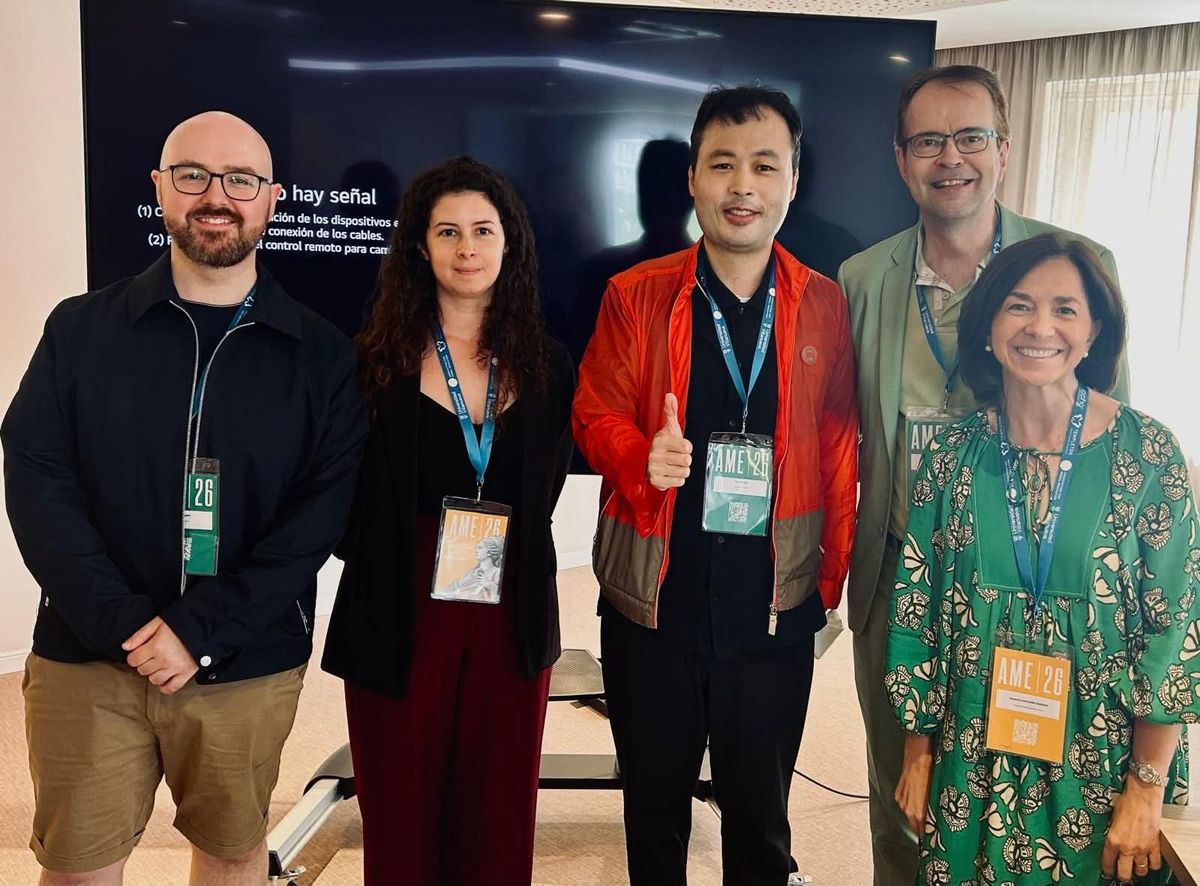
I am writing this from Madrid airport, not long before boarding,* in that strange interval after a conference when the mind has not quite caught up with the body. The suitcase is packed. The lanyard has been removed. The coffee is overpriced. The conversations, however, are still very much alive.
My major reflection from AME this year is simple: you have to find your people in this game. Not merely people who work in the same area. Not merely people whose names appear in the same programmes, journals, handbooks, and symposia. Your people are the ones who care about what you care about. They are the ones whose questions sharpen yours, whose enthusiasm restores yours, and whose company leaves you less depleted than when you arrived. Academic life can be lonely, competitive, status-conscious, and absurdly performative. But when you find the right people, it becomes something else entirely. It becomes generative.
And oh boy, there were people. Everywhere I turned at this conference, someone seemed to initiate a conversation. Senior scholars. Early-career researchers. Doctoral students. People I knew well. People I had never met. People who had read something I had written. People who wanted to talk about practical wisdom, character, measurement, moral psychology, or the sheer difficulty of doing serious work in a field where the most important things are rarely the easiest things to study. Some people wanted photos. That was especially strange. Pleasant, of course, but strange. There is no single moment when one becomes “known” in academia. No bell rings. No official arrives with a certificate. No one says, “Congratulations, from this point onward, people will recognise you at conferences and want to speak to you.” It sneaks up on you, if it comes at all.
And that is probably for the best. Recognition is better when it arrives as a by-product rather than an ambition in and of itself. Better when it grows quietly out of the work, the conversations, the collaborations, the risks, the Reviewer 2s that nearly broke you, the talks you gave to half-empty rooms, and the people who took you seriously before there was any obvious reason to do so. If you chase the limelight before its time, you may get attention, but attention is not the same as contribution. Self-promotion is not always avoidable, if course. In fact, some version of it is necessary. We work in systems that count things: citations, grants, invitations, downloads, impact, esteem, income, outputs - as ought to be the case especially if funded by working people's taxes. It is fashionable to sneer at metrics, but the brutal truth is that metrics are often part of what gets you in the door, keeps you in the room, and gives you the freedom to keep doing the work that matters.
So yes, you have to make the work visible. You have to play enough of the game to protect the thing you entered the game to do. But there is a line, and for me that line is unearned status. Visibility should follow contribution, not replace it. Promotion should illuminate the work, not substitute for it. The danger is not ambition. The danger is narcissism wearing ambition’s coat. The better path, I think, is this: do good work with good people. Ask and answer the hardest, deepest questions you can bear to touch. Not the questions that are easiest to fund this year. Not the questions that sound fashionable in a strategic plan. Not the questions that let you add one more footnote to a debate nobody outside your WhatsApp group understands. The deepest questions are the ones that remain alive when the jargon changes, the technology changes, the politics changes, and the funding calls move on.
What makes a life go well? How do people become good? What do we owe to one another? How can institutions form rather than merely process human beings? How do we measure the things that matter without destroying them in the act of measurement? Those are the questions that keep the academy morally alive. The humanities and social sciences sit at the heart of what a university is for, not because they are always well practised, but because they ask what human beings are, what they might become, and what forms of life are worthy of them. If you have an insatiable hunger to ask those kinds of questions, and you cannot quite switch it off, then you may be meant for academic life in some form. Not everyone is. That is fine. But for some people, they do not have questions. Its the other way around - the questions have them.
This conference made me feel, perhaps more than any before it, that something has changed. I found myself wondering whether I had turned a corner into becoming someone whom people recognise. "Mid career", perhaps. Somewhere closer to full professor than PhD student, yet not quite there yet either. I am still not quite sure what to do with that feeling. Part of me finds it absurd. Little old me? Really? But another part of me recognises the slow accumulation behind it: many years, many conferences, many awkward rooms, many moments wondering whether I would have someone to talk to. I remember arriving at events and scanning the room, trying to identify a friendly face. I remember hovering near coffee tables, pretending to read the programme while quietly hoping someone would start a conversation. I remember the odd mixture of ambition and invisibility that marks the early years of academic life. You want to belong, but you are not yet sure whether the room has noticed you exist.
It is funny how it changes. Not all at once. One meaningful conversation at a time. As an introvert, I usually find back-to-back conversations draining. I like people, but I also need silence and considerable time with my own thoughts. Yet this conference felt different. It was still tiring, of course. No amount of goodwill makes constant sociability metabolically free. But the tiredness was counterbalanced by something more rewarding: the ease of being oneself around people who do not require a performance. When people care about the same questions, conversation becomes less like small talk and more like shared excavation. You are not selling yourself. You are digging together in a liminal space.
That is the strange gift of finding your people. You can spend hours speaking and still feel, underneath the fatigue, more alive than before. Recognition, when it is healthy, is not simply the thrill of being noticed. It is the relief of being recognised accurately. People are not responding to a persona. They are responding to the work, the questions, the commitments, the peculiar little constellation of things that make you you. That is why it felt especially poignant to see newer scholars at AME, some of whom seemed nervous to say hello. Nervous to speak to me, of all people. I hope I responded in a way that made them feel valued as people, included in the conversation, and taken seriously as scholars. I hope I made the threshold feel lower rather than higher, because I remember what it is like to stand at the edge of a field and wonder whether you will ever find a way in, for lack of a better way of putting it. No one should have to grovel for intellectual belonging. But almost everyone has to last long enough to find the people among whom belonging becomes possible.
The most palpable sense of shared excitement came during the final symposium in which we presented updates on work involving the Short Phronesis Measure, which I created with Steve Thoma and Kristján Kristjánsson. The measure was officially published just over a year ago and, at the time of writing, has already been cited almost 70 times. You never quite expect anything you write to have that kind of reach so quickly. You hope, of course. More importantly, in the world we inhabit, you often need it. If a subject genuinely matters, it needs enough visibility, evidence, and uptake to become economically and institutionally defensible. Metrics are not the soul of scholarship, but they often guard the door through which scholarship must pass. What made the symposium so special was not that I had so much to say. In fact, I was very happy to take something of a back seat. Hyemin Han, Verónica Fernández Espinosa, and Marta Velázquez-Gil presented updates on work they had led. Hyemin chaired the session with warmth and clarity. Kristján closed with a characteristically elegant summary of what we know, what we do not yet know, and why the people in the room should help us find out more. That, to me, is one of the best feelings in academic life: watching something you helped give to the world become useful in the hands of others.
There is a particular joy in seeing colleagues take an idea, extend it, test it, translate it, challenge it, and make it better. That is when you know the work has begun to matter beyond the paper itself. It is no longer simply something you published. It has become something other people can think with. That, I suspect, is what good scholarship should do. It should not sit obediently inside the author’s original intentions. It should become useful, arguable, revisable, portable. It should give other people a way to ask better questions than they could ask before.
The audience mattered too, and not simply because every presenter wants a good audience. Their questions and interest suggested something broader than niche enthusiasm. It is one thing for your close collaborators to care about your special topic. It is another for people outside that immediate circle to see why it matters. That is much harder to achieve, and I wish I had a formula for it. The best I can offer is this: learn to explain, in one or two sentences, why your work matters in the bigger picture. Not in the private language of your subfield. Not behind a thicket of sophisticated-sounding jargon. In language that an intelligent person outside your immediate area can understand. When I was doing more niche experimental psychology, I often wrapped the work in terms that made me sound cleverer than I was and made the work less useful than it could have been. Since practising the discipline of explaining the point simply, I have found that the work travels further. The old adage rings true in my experience: if you cannot explain it simply, you probably do not fully understand it. Simplicity is not the enemy of sophistication. It is often the test of your lucidity.
And so I return to the importance of people. Not all people, of course. Academic life also teaches discernment. One still encounters senior figures who seem interested in a conversation only insofar as it offers them something: influence, access, validation, proximity to power, or another opportunity to advertise themselves. These encounters are rarely catastrophic. Often, they are simply clarifying. They remind you that status is not the same thing as seriousness, name recognition is not the same thing as wisdom, and holding the purse strings is not the same thing as having earned one’s stripes as a scholar. The question, in the end, is what will remain of us when we no longer control the room, chair the panel, distribute the opportunities, or command attention by force of title.
But discernment cuts both ways. Some people who appear abrasive, disagreeable, or self-interested in public have quietly opened doors for others when they had nothing obvious to gain. Some of the most generous acts in academic life happen offstage, without announcement, without branding, and without the benefactor converting kindness into reputational currency. Sometimes harsh criticism and high expectations are the making of you. The best scholars understand that and offer criticism in that spirit: not to humiliate, not to dominate, but to call forward the better version of the work, and sometimes the better version of the scholar. So do not get too caught up in charisma or fame. Look instead at who takes you seriously when they do not stand to personally benefit, who lifts you up without needing an audience, and who criticises you because they suspect the best version of you has not yet revealed itself. The point is not to divide the field too neatly into saints and villains. People are more complicated than their conference manner. The better lesson is to pay attention over time. Notice who takes more than they give. Notice who gives when nobody is watching. Notice who makes junior people feel bigger rather than smaller. You may be surprised who has a good heart and who does not, once you get beyond your own short-term needs.
One of the great gifts of experience is learning where not to spend your energy. Not every slight deserves a grievance. Not every ego deserves analysis. And it's rarely a reflection on your worth. Sometimes people show you, quite clearly, how they move through the world. Believe the evidence - the world is giving you information. As a senior researcher said to me at a conference eleven years ago, “Don’t let the ******** get you down.” We're all adults here, so I'll let you fill in the blank! I have found this to be excellent academic advice and, in several contexts, a respectable theory of social resilience too.
The more important lesson is a positive one: do exciting things with people who are excited by the bigger picture you hope the work fits into. This sounds almost too simple, but it may be the whole trick. Find the people who make the work feel more possible, yes, but also find the people who still believe that the work can matter beyond the usual half empty room during the Sunday morning graveyard shift at the conference you attend more out of habit than because it is intellectually nourishing. Some excellent scholars become cynical and jaded. They publish only in backwater journals, present to the same few people they message every day anyway, and mistake familiarity for community. I understand the temptation. Rejection hurts. Top journals can be brutal. The wider field is not always fair, wise, or even especially attentive. But why not test your mettle anyway?
As Ted Lasso says, "be a goldfish".
If someone criticises your work in a serious journal, take it seriously. Not servilely. Not as if every reviewer were an oracle and every rejection was the right decision. But seriously enough to ask, as if you genuinely want to know the answer, what stronger writers, sharper theorists, and more successful scholars are doing better than you. Do not imitate them flatly. That way leads to academic ventriloquism. And academic ventriloquism is everywhere. Some senior scholars can go thirty years without making a meaningful original contribution or without ever having proven their theory to be empirically correct and still arrive at conferences surrounded by admirers. Some become charismatic “names”, idolised by people who do not yet know enough to distinguish intellectual substance from professional theatre. They make sweeping claims that nobody else could ever get away with if they had the gall to even try. They attract money, invitations, and attention. They acquire entourages. They become less like scholars and more like portable institutions. It is so tempting as a young scholar to be part of that entourage and try to emulate their way of being. It seduces the narcissist in us all if we're not careful.
Learn from successful people, certainly. Study what they do well. Notice how they frame questions, structure arguments, pitch ideas, and make their work matter to audiences beyond their immediate niche. But do not become the dummy with someone else’s hand up your back. Admiration should sharpen your originality, not replace it. The point is not to sound like the people who have already made it. The point is to become more fully capable of making the contribution only you can make.
This is one of the reasons I love serious philosophical and theoretical exchange. In philosophy, criticism can be a mark of respect. Someone presses your argument because they think it is worth strengthening. Someone identifies the weak point because they believe there is a stronger version of your position still waiting to be born. The best colleagues do not flatter your argument into mediocrity. They criticise it into shape. Find those people. Find the people whose success makes you glad rather than diminished. Who show off your work and don't diminish you to others because they are territorial. Find the people who are serious without being pompous, ambitious without being craven, clever without being cruel. Find the people who will tell you when your argument is weak because they want it to become strong. Find the people who care more about the quality of the programme than the seating plan.
Seniority matters, but not as much as people think. Often, it means little more than busyness and lots of emails to get through. Decent people do not care very much how old you are, where you are on the ladder, or whether knowing you advances their career. They care whether you are doing something worthwhile. They care whether the conversation has life in it. They care whether, together, you might be able to understand something that matters. For younger scholars, if any happen to read this, I would say: take the risk of saying hello. The nice people will be nice. The serious people will take serious interest. The generous people will not make you feel foolish for being early in the journey, for making a faux pas, for asking a clumsy question, or for not yet doing the best possible version of the work you may one day do. And if someone makes you feel small because they are scanning the room for someone more important, that is useful information. You have not failed the encounter. The encounter has revealed itself and you have learned something about the person.
But I would also say this: do not try to seize the limelight before it is yours. Work first. Ask better questions. Write better papers. Build better collaborations. Learn the literature - and adjacent literatures from other fields - so deeply that your contribution becomes a necessity rather than a performance. The limelight, if it comes, is sweeter when it sneaks up on you. Even then, one has to be careful. Recognition can give you a little sugar high if you let it. Likes, photographs, invitations, praise, citations, and name recognition all feel nice. There is no point pretending otherwise. But the healthier feeling is not intoxication. It is something more like gratitude. Not "thanks for making me feel so good", but "I am grateful to get to be a meaningful part of meaningful work". It is the sense that whatever visibility you now have brings a burden of stewardship. You have to practise being thankful without becoming credulous about your own importance. Never quite believing you deserve it, but remaining open to the possibility that maybe you did and that is for others to judge, so you'll do your best to serve as long as you're called upon. Know your strengths. Know your limitations. Remember that recognition is not an endpoint. It is more like a transition towards a different kind of service to the field you love, with more responsibility. The good kind. But like with any true love, it is not about you and what you can get from it.
And when some recognition does come, even a little, the best use of it is not to stand in it alone. The best use of recognition is to redirect attention towards work that matters and people who deserve it. At this conference, I found that I did not particularly need to overclaim credit or self-promote. I had opportunities to sit back, at least for a while, and enjoy showing off the brilliant work my friends and colleagues had done. That is a much better feeling. You get to feel part of a tapestry of work that will live on past you. You step back and, just for a moment, appreciate the moment while it is happening.
Perhaps that is what I am taking from AME this year. The work matters, of course. The ideas matter. The measures, theories, methods, and arguments matter. But they matter most when they become part of a shared endeavour. Scholarship is not only a record of what we have thought. It is also a record of who helped us think better. So, if the deepest questions will not leave you alone, follow them. Ask what matters when the fashions change. Ask what remains true when the funding priorities move on. Ask what human beings need in order to live well, become good, and build institutions that steward the best of our culture, not merely problematise the worst of it. Find the people who want to ask those questions with you, and who make you braver in asking them.
Sitting here in Madrid airport, tired and grateful, that feels like the thing worth saying as I reflect on AME 2026. *It turned out to be many hours before boarding, after a storm grounded our plane. After I finished writing, I was joined by two wonderful colleagues, Michael and Laura, who made the shared ordeal much more tolerable. Further evidence, perhaps, for the thesis of the whole piece.