Why Moral Psychology and Moral Education Need Behaviourism
Moral psychology is not the study of free-floating ideals, but the study of how human beings come to value, choose, regulate, cooperate, sacrifice, persist, harm, repair, and change. Moral education is not the transmission of attractive words, but the deliberate shaping of environments in which pupils learn what kinds of conduct are possible, worthwhile, costly, rewarded, expected, and admired.
Both fields must be nested within evolution. This is not a decorative gesture towards sounding scientific. It is the condition of scientific consilience - at once, the most basic and profound thing for a theory that involves humans to do. Consilience means that explanations at different levels should fit together rather than contradict one another. A theory of moral psychology should not require one picture of human beings in philosophy, another in psychology, another in biology, and another in education. It should explain moral conduct in the same kind of organism studied by evolutionary biology, behavioural science, neuroscience, developmental psychology, and education.
Put simply, we cannot explain moral behaviour as if human beings were disembodied choosers who happen to own bodies. We are biological organisms first. We have bodies and brains because ancestral environments selected organisms with compounding minor variations that helped them solve recurrent problems of survival, learning, reproduction, cooperation, threat detection, attachment, status, care, exploration, and adaptation. Any account of ethics or education that forgets this begins far too late. It starts with moral ideals after skipping the organism expected to live by them.
This is why moral psychology and moral education need behaviourism. Not the caricature of behaviourism that still appears in many textbooks, where it is reduced to a narrow stimulus-response theory, a denial of thought, or a crude account of external rewards and punishments. That version has become an academic folk tale, often repeated by people who have read the secondary mythology more carefully than the primary texts. One can reject behaviourism after reading Skinner, Watson, Thorndike, Tolman, Kantor, Staats, Bijou, Baer, Sidman, or the broader behavioural tradition. What is less impressive is the professional habit of dismissing it as obviously simplistic while relying on strawman summaries written by its opponents.
The irony is that behaviourism is often accused of being shallow by critics who have not done the shallowest thing required of scholarship: read the classic texts. Myths then proliferate. Behaviourism becomes the view that people have no thoughts, that feelings do not matter, that all learning is mechanical, that humans are rats in slightly larger boxes, or that moral education would consist of handing out stickers until children behave. None of this is serious. It is intellectual evasion masquerading as sophistication.
The behaviourism I mean here is a science of organism-environment relations. Its central question is simple but demanding: what histories of selection make this behavioural event more or less likely?
The phrase “behavioural event” matters. In a behaviourist analysis, behaviour does not mean only publicly visible movement. A behavioural event can also be a thought, feeling, image, urge, memory, expectation, verbal rule, private rehearsal, or bodily sensation. B. F. Skinner, one of the central figures in twentieth-century behaviourism, did not give special causal status to private behaviour simply because only one person can observe it directly. Nor did he treat neural behaviour as a separate explanatory kingdom. Public behaviour, private behaviour, and neural events all belong within the same organism-environment framework. They differ in accessibility, not in kind.
This matters because moral psychology is full of private events. Guilt, shame, pride, compassion, resentment, temptation, hope, fear, and moral identity are not outside behaviour. They are parts of the behavioural stream shaped by phylogeny, ontogeny, and culture. A pupil’s impulse to retaliate, a teacher’s feeling of guilt, a parent’s anxious thought, and a leader’s private rehearsal of a difficult conversation are all behavioural events in this wider sense. They can be elicited, strengthened, weakened, organised, and transformed by histories of selection.
Virtues are therefore not merely labels for admirable qualities, but relatively stable patterns of public and private responding. Values are not merely private preferences, but verbal descriptions of behaviour-consequence relations that organise conduct across situations. Character is not a hidden substance inside the person, but a pattern of responding, including thinking and feeling, shaped across biological, developmental, and cultural histories.
Consider two pupils who both fail to apologise after hurting a classmate. One understands perfectly well what happened, but refuses to apologise because apology has become associated with loss of status. The other struggles to infer the classmate’s emotional state and does not immediately see why the incident matters. The visible behaviour is the same. The functional meaning is different. The private behavioural events may also differ: one pupil may feel defiance, the other confusion; one may think apology signals weakness, the other may not yet understand the harm. Moral education that responds only to the surface behaviour will miseducate at least one of them.
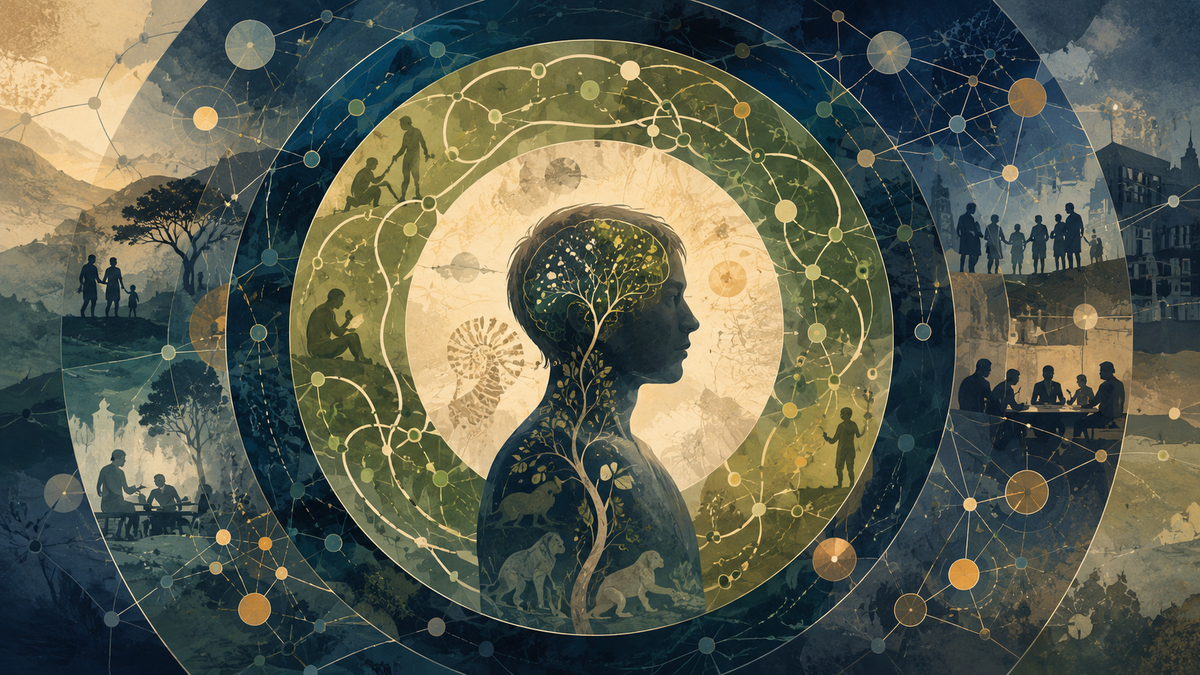
Skinner’s most important contribution for present purposes was his account of three environments that shape behaviour: phylogeny, ontogeny, and culture. Phylogeny refers to the evolutionary history of the species. Ontogeny refers to the learning history of the individual. Culture refers to the transmission and selection of shared practices across groups and generations. This three-part account places human behaviour inside an evolutionary framework without reducing everything to genes. Environments select biological characteristics across evolutionary time. Environments select behavioural repertoires across an individual lifetime. Environments select cultural practices across social history.
The argument I am making in this essay takes Skinner’s framework as its starting point and then extends it. Skinner articulated the three environments of selection. The next task is to ask which of these environments, if any, confer normative oughts. That movement, from behavioural selection to moral normativity, is the crux of what I am proposing here. The claim is not that Skinner already gave us a complete normative ethics. The claim is that his framework allows us to build one with unusual clarity. A theory of morality is not scientifically adequate if it bypasses these three environments. It may still offer a vocabulary for moral judgement, but it will not explain how moral conduct emerges, why it varies, how it is maintained, or how it can be educated.
Behaviour begins with phylogeny
Phylogeny is not moral destiny, but the biological starting point of moral life. The reason we have bodies and brains at all is that ancestral environments selected organisms with characteristics that helped them survive and reproduce in those ancestral environments. Natural selection did not design us by consulting a moral theory. It preserved variations that worked well enough under past conditions.
This point needs careful explanation because the word “selection” can make the process sound more deliberate than it is.
First, organisms vary. Within any population, there are small differences among organisms. Some differences arise through mutation, some through recombination. Some affect bodies, nervous systems, sensory thresholds, hormonal systems, temperamental tendencies, learning capacities, or patterns of reactivity. These variations are usually small. They do not arrive as complete transformations. Nature does not suddenly produce a modern brain, a moral agent, or a perfectly calibrated nervous system. It produces slight differences that compound, generation after generation.
Second, environments contain recurrent problems. Organisms must find food, avoid danger, regulate temperature, detect threat, reproduce, care for offspring, navigate alliances, compete for status, learn from pain, and respond to uncertainty. These problems do not select for ideals. They select workable differences. A slight improvement in threat detection may matter for survival. A slight improvement in memory may matter. A slightly stronger attachment response may matter. A slightly better capacity to learn from consequences may matter.
Third, useful variations make survival and reproduction more likely. A nervous system that detects threat quickly may help the organism avoid injury. A capacity for attachment may help offspring survive. A tendency to learn from consequences may help organisms avoid repeating costly mistakes. Sensitivity to social approval and rejection may help individuals remain within cooperative groups. Over many generations, small advantages compound. The population changes. Characteristics that were once minor variations become more common. This is how biological design emerges in response to the environment without a designer.
The crucial step for ethics is that ancestral selection prepares us only for environments sufficiently similar to the selecting past. Natural selection does not have foresight. It does not know about smartphones, mass schooling, online pornography, industrial food, social media, artificial intelligence, GCSE examinations, university admissions, global capitalism, or modern bureaucracies. It equips organisms with capacities and tendencies that were useful before. Those capacities may help now, misfire now, or require correction now.
Appetite is a simple example. Humans evolved in environments where calories were harder to obtain than they are for many people today. A taste for sugar and fat made sense when energy-dense food was scarce. In a modern supermarket, the same tendency can become maladaptive. The fact that we desire something does not mean we ought to indulge it.
Threat detection offers another example. A nervous system that quickly detects danger is useful in dangerous environments. But the same system may produce anxiety in a classroom, meeting, or email exchange where the threat is social rather than physical. The fact that a pupil’s body reacts as though a presentation is dangerous does not mean the presentation is actually dangerous, nor that it is morally bad. It means an inherited threat system is responding to a modern environment.
Status sensitivity offers a third example. Human beings evolved in groups where reputation mattered. Social exclusion could be a matter of life and death. That helps explain why pupils may fear humiliation, seek peer approval, copy dominant peers, or avoid looking foolish. But the fact that status anxiety is natural does not mean it should govern conduct. A pupil may feel a strong urge to mock another pupil to gain approval. The origin of that urge explains it. It does not justify it.
Natural selection therefore gives us capacities, tendencies, vulnerabilities, and starting points. It does not give us moral guidance, affecting what we ought to do.
This matters because people do not begin moral life as interchangeable agents. They differ in intelligence, temperament, personality, disability, emotional reactivity, inhibition, sociability, reward sensitivity, anxiety, sensory experience, and capacity for perspective-taking. These differences shape what moral demands feel like, how difficult certain forms of conduct are, and what kinds of moral education are likely to work.
A person with high emotional stability does not face the same regulatory task as a person prone to panic. A highly conscientious person does not experience disorganisation in the same way as someone with weaker impulse control. A socially intuitive person does not have to infer interpersonal meaning in the same way as someone who struggles with social cognition. These facts do not determine moral worth, but they do determine moral context.
For example, a school may teach courage by encouraging every pupil to speak publicly in assembly. For one pupil, this may be a manageable stretch that builds confidence. For another, with severe social anxiety or selective mutism, the same demand may be experienced as threat, humiliation, or coercion. The virtue is not necessarily wrong (in the sense that it is probabilistically better to have virtue than not), but the behavioural route to the virtue differs. Courage for the first pupil may involve speaking to a large group. Courage for the second may begin with asking one question in a small seminar, then making eye contact during a conversation, then recording an audio reflection. The moral direction is shared. The developmental pathway is personal.
Phylogeny also prevents a common moral error: confusing biological endowment with virtue. A person should not receive moral credit for simply possessing traits that nature made easy, nor moral blame for lacking traits that nature made difficult. If ancestral environments selected a characteristic because it helped organisms adapt to those ancestral environments, then the characteristic tells us something about past adaptive value. It does not tell us what is morally required now. Past usefulness is not present obligation.
Some people may be naturally bold. Boldness may have had advantages in ancestral environments where quick approach, competition, exploration, or defence mattered. But natural boldness is not the same as courage. A naturally bold pupil who speaks up without fear has not necessarily acted more virtuously than an anxious pupil who asks one difficult question despite trembling. The first pupil may have more biological ease. The second may show more moral progress.
Some people may be naturally agreeable. Agreeableness can support cooperation, care, and social harmony. But it can backfir for particular individuals in particular contexts. A highly agreeable pupil may avoid conflict even when another pupil is being treated badly. A less agreeable pupil may be the one who says, “This is unfair.” The inherited tendency does not settle the moral question.
Some people may be naturally intelligent. Intelligence helps people learn, reason, plan, and understand complex consequences. But intelligence is not wisdom. A clever pupil may use intelligence to manipulate, excuse, dominate, or evade responsibility. A less intellectually fluent pupil may show better character by consistently telling the truth, keeping promises, and repairing harm.
Some people may have disabilities that make certain forms of conduct harder. A pupil with impaired impulse control may find calm waiting more difficult. A pupil with social-cognitive difficulty may find perspective-taking more effortful. A pupil with anxiety may find public courage more costly. These differences do not remove moral education, but they change what moral education must ask. We should not judge moral worth by comparing visible behaviour alone. We should ask what responsible growth looks like given the pupil’s capacities and constraints.
A naturally calm pupil who never lashes out is not necessarily more virtuous than an irritable pupil who suppresses the tenth angry response of the day. A gifted pupil who produces articulate moral reasoning is not necessarily wiser than a less verbally fluent pupil who quietly keeps a difficult promise. Moral worth cannot be read directly from polished performance.
Behaviour is shaped across a lifetime
Ontogeny is the level at which ordinary behaviour is selected across a person’s lifetime via conditioning. Natural selection can produce learning systems, but it cannot pre-install every adaptive response to every local, temporary, or novel contingency.
This is why humans learn at all. Actions that work tend to recur. Actions that fail, hurt, or produce adverse consequences tend to weaken, unless other consequences maintain them. People develop habits, avoidance patterns, skills, routines, expectations, fears, manners, strategies, dependencies, and forms of self-control because their environments have selected these repertoires.
This is not a reduction of moral life, but an explanation of its formation. A pupil who lies has learned something about truth-telling and its consequences. A pupil who avoids effort has learned something about failure, shame, reward, or escape. A pupil who interrupts may have learned that interruption is the only reliable route to attention. A pupil who appears compliant may have learned that safety depends on pleasing adults. A pupil who resists authority may have learned that authority is unpredictable, humiliating, or unjust.
Teachers are part of this ontogenetic environment. Their responses, expectations, routines, praise, sanctions, attention, modelling, warmth, impatience, consistency, and inconsistency become part of the contingencies through which pupils learn. A teacher who calmly helps a pupil repair harm teaches a different lesson from a teacher who humiliates the pupil into silence. A teacher who notices effort teaches a different lesson from a teacher who notices only errors. A teacher who rewards articulate confidence more than careful thinking may unintentionally select performance over understanding.
Suppose a pupil repeatedly says, “I do not care,” whenever work becomes difficult. A purely moralistic interpretation treats this as laziness or lack of perseverance. A behaviourist interpretation asks what the phrase does. It may allow the pupil to avoid the task, protect the pupil from looking stupid, invite peer approval, or shift the teacher’s attention away from academic failure and towards behaviour management. It may also be accompanied by private behaviour: the thought “I will fail anyway”, the feeling of shame, the urge to escape, or the bodily sensation of anxiety. These private events matter, but they do not require a different science. They are part of the same behavioural episode.
Such observations do not excuse all behaviour. Explanation is not exoneration. They tell us where moral education must begin. Moral education is not merely the correction of visible conduct, but the reshaping of the contingencies that make some patterns of conduct more likely than others.
For instance, a school that wants honesty cannot simply tell pupils that honesty matters. It must make truth-telling survivable. If pupils are punished more harshly for admitting wrongdoing than for concealing it, the school is selecting deception while praising honesty. If teachers say they value reflective learning but reward only flawless performance, pupils will learn impression management. If mistakes are too readily perceived to be evidence of low ability, pupils will learn avoidance. The moral lesson is carried by the consequences pupils encounter, not by the words adults display.
Ontogeny also shows why self-regard has moral significance. People must adapt to the concrete demands of their lives. They must preserve their health, maintain relationships, meet obligations, regulate emotion, repair damage, and develop the skills required to live well. Looking after oneself is not merely instrumentally useful because it enables service to others. It is part of what moral life requires. A person is not only a contributor to other people’s flourishing, but a locus of flourishing in his or her own right.
A teacher who works until midnight every evening may appear committed. Yet if that pattern destroys health, patience, family life, and long-term effectiveness, it is not obviously virtuous. It may be conscientiousness selected by institutional pressure. It may be fear of criticism dressed as dedication. Good moral education should not teach pupils or teachers to treat self-exhaustion as moral excellence.
The ontogenetic environment therefore generates genuine moral demands. People ought to respond wisely to the conditions of their own lives. They ought to learn from consequences, organise their conduct, and develop repertoires that allow them to function, relate, contribute, and flourish.
Culture transmits what individuals cannot learn from scratch
Culture is a third form of selection. It is necessary in evolutionary terms because individual learning is costly, slow, and dangerous. If every person had to learn every useful pattern through direct trial and error, human beings would waste lifetimes rediscovering what others already know. Culture allows useful patterns of behaviour to be transmitted without each individual having to repeat the original learning history from which those patterns emerged.
A child does not need to discover through trial and error that fire burns, promises matter, theft damages trust, effort usually improves skill, or cruelty can poison a community. A community can teach these things. Culture carries behavioural discoveries across lives.
Some behaviours learned by individuals become useful, meaningful, or compelling to others. They are copied, taught, praised, ritualised, formalised, and transmitted. Over time, these patterns become norms, customs, virtues, institutions, educational ideals, and moral expectations. This is where a behavioural account connects with evolutionary accounts of cultural transmission. Dawkins used the term “meme” to describe cultural units that spread by imitation. The point is not that all memes are wise. The point is that cultural practices persist because they are transmitted. Some survive because they solve recurrent human problems. Others survive because they flatter power, reduce anxiety, punish dissent, or make conformity easier.
Culture therefore explains both moral inheritance and moral error. It allows human beings to preserve useful practices beyond a single lifetime, but it also allows defective practices to persist long after their usefulness has ended. Cultural selection is not moral justification. A practice can survive without deserving to survive.
Saliently for the present essay, culture does, however, confer moral oughts. At minimum, we ought not to damage the shared environments in which others must live and learn. Better still, we ought to help others directly when doing so is proportionate and possible. Better again, we ought sometimes to behave in ways worthy of emulation, so that a pattern first learned in one lifetime becomes available to others without their having to learn it from scratch.
This is where idionomic and nomothetic virtue meet. Some behaviours are learned ontogenetically by particular people in particular circumstances. Most remain local. Now and again, a pattern proves general enough, or ergodic enough, that people with different biological capacities and learning histories can adopt it broadly. It becomes a cultural norm, a named virtue, a professional standard, or an educational ideal. The behaviour has moved from individual learning to cultural inheritance.
For example, a teacher may learn through experience that publicly humiliating pupils produces short-term compliance but long-term resentment, avoidance, and mistrust. She develops a better practice: correcting firmly but privately where possible. That practice can then be transmitted to other teachers. They need not each learn through years of damaged relationships that humiliation corrodes trust. The culture can carry the lesson.
Or consider restorative repair. A school may learn that, after harm has occurred, pupils develop better relationships when they identify what happened, who was affected, what responsibility requires, and how repair can occur. If that pattern works across pupils and contexts, it may become a broader educational practice. It began as learned conduct in particular settings. It can become a cultural tool.
Pupils also shape culture. A pupil who includes a socially isolated peer may create a small pattern others can copy. A pupil who refuses to laugh at cruelty may weaken a norm of mockery. A pupil who apologises well may model repair. A pupil who says, “We do not do that here,” may help turn private judgement into shared expectation. Moral education should show pupils that what they do contributes to the culture for good or ill. They are not merely shaped by culture; they help shape the culture that will shape others.
Consider a school culture in which pupils mock effort. No individual pupil needs to invent this norm. It is transmitted through jokes, eye-rolls, nicknames, status rewards, and social penalties. A new pupil quickly learns that visible effort carries reputational risk. The culture selects ironic detachment over diligence. A display about aspiration will not override that culture unless the school changes the contingencies that make effort socially costly.
The same applies to staff cultures. A department may say it values collegiality while rewarding the person who volunteers for everything, answers emails at night, and quietly absorbs everyone else’s workload. Over time, “being a good colleague” becomes culturally defined as being endlessly available. The practice persists because it solves short-term institutional problems, but it may damage the people who maintain it.
For moral psychology, this means that values and virtues must be studied as transmissible behavioural patterns, not merely as private mental contents. For moral education, it means that schools are not neutral settings in which character happens to be discussed. Schools are cultural environments. They select behaviour through rules, routines, sanctions, relationships, modelling, curricula, assessment systems, leadership practices, and informal norms.
A school does not only teach character through what it says. It teaches character through what it rewards, permits, ignores, and punishes.
From selection to normativity
The central philosophical question is how facts about behaviour can connect to moral oughts. A behaviourist account does not solve this by saying that whatever evolved is good, whatever is learned is good, or whatever culture preserves is good. Those claims confuse explanation with justification. The better answer is to ask which forms of selection create morally relevant demands. This is the step beyond Skinner. Skinner showed that phylogeny, ontogeny, and culture select behaviour. I am asking what follows normatively from that fact.
Phylogeny creates capacities and constraints, but not moral worth. It tells us what kind of organism we are dealing with. It does not tell us how good a person is. The reason is that phylogeny points backwards. It tells us what helped our ancestors survive and reproduce in environments like those of the past. Moral obligation points forwards and sideways. It asks how this person should act now, in this situation, with these capacities, among these people, under these cultural conditions, and with these likely consequences. A past-selected tendency may be useful, irrelevant, or harmful in the present. Therefore it cannot, by itself, confer an ought.
Consider aggression. Some aggressive tendencies may have been adaptive in contexts of threat, competition, or defence. That does not mean a pupil ought to hit someone who insults him. Consider jealousy. It may have roots in mate guarding, attachment, or fear of loss. That does not mean a person ought to control a partner. Consider in-group loyalty. The instinct towards this particular value may have supported group survival. That does not mean a child ought to lie for a friend who bullied another child. In each case, the evolutionary history explains why the tendency exists. It does not justify acting on it.
On the other hand, ontogeny and culure both confer normative oughts, as they are forward-looking in a way that phylogeny is not.
Ontogeny creates personal demands. A person’s life contains real contingencies that require adaptation. People must learn to live well in the environments they actually inhabit. They must develop conduct that preserves their own flourishing, supports their obligations, and enables responsible participation in the lives of others. Culture creates social demands. People live in shared environments that depend on transmitted practices. We therefore have reasons to contribute to cultural conditions in which different kinds of people can flourish. This is not only reciprocity. It is also prudence, responsibility, and legacy. We live in the environments we help maintain, and others inherit the environments we help create.
Suppose a pupil has a neurological condition that makes impulse control unusually difficult. The biological fact does not make the pupil bad. It also does not make classroom disruption irrelevant. Ontogenetically, the pupil still needs to learn strategies that help him act well in adapting to the present environment within his capacities. Culturally, the classroom still needs norms that allow other pupils to learn. The moral task is not to blame the pupil for his starting point, but to build a repertoire that respects his constraints and allows his personal flourishing while protecting the shared environment.
The result is a three-part account of normativity. We should not morally judge people for their phylogenetic starting points. We should judge how well they learn to respond to their ontogenetic circumstances given their capacity. We should also judge how their conduct contributes to cultural environments that shape the flourishing of others given their capacity.
Moral life therefore requires adaptation to self, situation, and shared world.
The agency paradox
A common objection is that behaviourism cannot sustain moral education because it appears to deny agency. The objection matters because moral education is not merely the arrangement of conditions under which pupils emit desirable conduct. It is the cultivation of responsible persons. We want pupils to become capable of truthfulness, repair, restraint, courage, concern, judgement, and responsibility. Those aims require agency, because agency is what allows us to attribute personal responsibility, and personal responsibility is what allows oughts to make sense.
To say that a pupil ought to apologise, ought to tell the truth, ought to repair harm, or ought to show courage is to address that pupil as someone capable of a responsible response. We may qualify that responsibility by age, disability, fear, coercion, ignorance, developmental stage, or learning history. Indeed, a behaviourist account helps us make those qualifications more carefully. But we cannot remove agency altogether without changing the subject. A stone does not owe anyone an apology. A reflex does not deliberate. A storm does not behave unjustly. Moral education begins where the person can be addressed as someone who might learn to respond otherwise.
This creates the behaviourist agency paradox. From a third-person perspective, the person is a product of the three environments. Their body and nervous system reflect phylogeny. Their habits, fears, skills, expectations, and patterns of self-talk reflect ontogeny. Their language, norms, ideals, and moral vocabulary reflect culture. Seen from the outside, behaviour can be analysed as the product of histories of selection. This is not a problem for behaviourism. It is one of its main strengths.
From the first-person perspective, however, agency is unavoidable. We cannot live as if agency does not exist. We deliberate before sending an email. We look before crossing the road. We decide whether to apologise, whether to tell the truth, whether to intervene, whether to wait, whether to speak, whether to keep silent. Even if every one of these behavioural events has a history, we still encounter life as requiring choice. The first-person question is not “am I caused?” but “what should I do now?”
A coherent behaviourism must hold both perspectives together. From the third-person perspective, it should explain how agency is shaped. From the first-person perspective, it must recognise that agency is the practical standpoint from which life is lived. Moral education operates precisely in the space between these perspectives. It recognises that pupils are shaped by biological capacities, learning histories, and cultural conditions, but it must still address them as agents who can be asked to deliberate, take responsibility, repair harm, inhibit impulses, and act differently. Without the third-person perspective, moral education becomes naïve moralism. Without the first-person perspective, it loses oughts altogether.
This does not require a supernatural account of agency. Agency is not an uncaused power floating outside the natural world. It cannot be outside nature, because nothing human can be outside nature. If deliberation, inhibition, perspective-taking, future planning, moral reflection, and self-regulation exist, they must exist as events in organisms with biological, learning, and cultural histories. Treating agency as natural does not debunk it. It makes it intelligible.
This is also why private events matter. A behavioural event can be public, private, or neural. Thoughts, feelings, urges, self-talk, images, bodily sensations, and future-oriented plans all belong within the same explanatory framework as overt conduct. They differ in accessibility, not in kind. Much of what we call agency occurs privately before it appears publicly. A person imagines a consequence, rehearses a sentence, notices an urge, compares alternatives, remembers a rule, inhibits an impulse, and then acts. These private events do not sit outside behaviour. They are part of the behavioural process through which responsible action becomes possible.
The paradox becomes especially clear when behaviourists deny agency too confidently. Behaviourists often argue that belief should be inferred functionally rather than topographically. The question is not merely whether a person says “I believe X”, but whether the person reliably behaves in ways consistent with X. On that criterion, behaviourists believe in agency in more cases than not.
They plan papers, submit grants, avoid traffic, keep appointments, teach students, complain about bad reviews, revise arguments, choose restaurants, lock doors, look both ways before crossing the road, and arrange environments so that people behave differently. These are not the actions of people who functionally treat themselves as passive conduits of causal force. In ordinary life, they treat themselves and others as beings who can deliberate, choose, inhibit, learn, explain, justify, and take responsibility. Only in narrower professional conversations do some deny the agency their conduct otherwise presupposes.
The point is not to mock behaviourism from outside. It is to make behaviourism internally consistent. If belief is functional rather than merely verbal, then the functional evidence is overwhelming: behaviourists act as if agency exists. They avoid walking into traffic because they treat looking, judging, waiting, and crossing as meaningful actions under their control. They submit revised manuscripts because they treat criticism, deliberation, rewriting, and resubmission as meaningful routes to better work. They arrange contingencies because they believe people can respond differently when environments change. Their practice is wiser than their occasional rhetoric.
A better behavioural account therefore treats agency functionally. Agency is not an inner monarch exempt from causality. It is the learned and biologically enabled capacity to deliberate, anticipate, inhibit, select among alternatives, modify contingencies, and act under the control of reasons, goals, values, and consequences. It is not freedom from influence. It is the capacity to respond well under influence.
For moral education, the implication is direct. Pupils are not blank wills who can simply choose virtue by intellectual assent, but neither are they passive products of conditioning. They are developing organisms whose repertoires can become more flexible, reflective, stable, and normatively guided. Moral education should therefore cultivate the forms of agency required for responsibility: attention, self-regulation, perspective-taking, truthful speech, repair, deliberation, and practical judgement. We need agency to attribute personal responsibility, and we need personal responsibility to make sense of oughts. Behaviourism can accommodate this, provided it stops mistaking agency for magic. A naturalised agency is not a threat to moral education. It is what makes moral education possible, so that we can avoid the undiscerning entropy of treating all values as mere moral facts, rather than ideas about how to flourish that can be more or less correct.
Why prosociality is not enough
The simplest evolutionary account of morality says that ethics evolved because prosocial behaviour helped groups survive. This is partly true, but incomplete. Prosociality is not equivalent to goodness. Helping others can be generous, prudent, coerced, pathological, self-erasing, status-seeking, or destructive. A person can benefit others while damaging herself. A pupil can appear kind because he cannot tolerate disapproval. A teacher can be praised for dedication while being trained into burnout. A child can become compliant without becoming good. A culture can call sacrifice noble when it is actually exploiting the conscientious.
Imagine a pupil who always gives up his lunch break to help classmates, never refuses requests, and never complains. The behaviour is prosocial. It may also be fear-driven. If the pupil is exhausted, resentful, and unable to protect his own learning, the behaviour should not automatically be praised as generosity. It may need recalibration towards assertiveness. The good is not selfishness, but neither is it self-erasure.
This is why moral psychology and moral education need a standard richer than prosocial behaviour. Goodness cannot mean simply producing benefits for others. It must also include the person’s own flourishing, capacities, history, responsibilities, and the cultural effects of the conduct being reinforced. The question is whether this behaviour helps this person, with these capacities and obligations, live well with and for others in a shared world worth sustaining.
Moral theories through a behavioural lens
A behaviourist framework helps clarify the strengths and limits of the main normative theories.
Deontology is not wrong because it emphasises duties, but incomplete when it treats duties as sufficiently responsive to personal capacity and context. Its strength is that it protects moral judgement from preference, fashion, and convenience. Its weakness is that universal rules can become insensitive to phylogenetic and ontogenetic variation. “Always tell the truth” has moral force, but truthful disclosure is not the same task for every person in every context. A powerful adult admitting a mistake in a meeting faces one kind of cost. A vulnerable child disclosing mistreatment by a popular peer faces another. The duty matters, but the moral and educational response must consider risk, power, capacity, and likely consequences.
Consequentialism is not wrong because it emphasises outcomes, but incomplete when it treats persons mainly as producers of aggregate benefit. Its strength is that it refuses to ignore the effects of conduct. Its weakness is that it can underplay the organism who must bear the cost. If moral worth is evaluated by maximised contribution, then people with lower capacity, disability, illness, or fewer opportunities can be unfairly judged as morally deficient. A pupil with limited perspective-taking may not produce the same visible quantity of compassionate behaviour as a socially fluent pupil. A crude consequentialist view may judge only the interpersonal outcome. A better view asks what progress, effort, and calibration look like given this pupil’s actual capacities.
Values-based approaches are not wrong because they emphasise personal endorsement, but incomplete when they treat endorsement as sufficient for moral significance. By endorsement, I mean the process by which a person identifies something as important to them: “I value freedom”, “I value loyalty”, “I value achievement”, “I value authenticity”, or “I value kindness.” This matters because people are more likely to pursue patterns of conduct that they can verbally organise as personally meaningful. Values can motivate, orient, and stabilise behaviour. The problem is that endorsement is not evaluation. A person can sincerely value something selfish, cruel, foolish, or destructive. People can also value domination, revenge, purity, intoxication, status, ideological conformity, or self-neglect. Institutions can value efficiency while burning out staff. Families can value loyalty while protecting abuse. Schools can value aspiration while humiliating the less able. Values without discernment produce values entropy: an expanding field of personally endorsed directions with no adequate standard for deciding which are worth pursuing. For example, a pupil may say that loyalty is his core value, but use loyalty to justify covering for a friend who bullied another pupil. An employee may say that excellence is her core value, but use excellence to justify contempt for colleagues. A school may say that aspiration is its value, but enact aspiration as pressure, fear, and ranking. The word “value” does not settle the moral question. We must ask whether the value organises behaviour towards genuine flourishing.
Virtue ethics is not wrong because it emphasises cultivated excellence, but incomplete when idealised standards fail to apply fairly in individual instances. Its strength is that it focuses on stable patterns of character rather than isolated acts, rules, or outcomes. Its weakness is that virtue language can become unfair when ideals are applied without adequate attention to biological capacity, learning history, role, risk, and circumstance. The problem is not that virtue ethics says virtue must look identical in every person. Aristotle’s golden mean is already more subtle than that. The problem is that named virtues can become idealised standards treated as if they apply straightforwardly across persons when individual cases require finer calibration. For example, resilience can name a genuine virtue when it means proportionate persistence through difficulty. It becomes vicious when it means tolerating unreasonable conditions without protest. A pupil who persists through a hard maths problem may be developing resilience. A teacher who silently absorbs an impossible workload may be participating in a culture that misnames exploitation as character.
The problem, then, is not that moral theories are useless. Each captures something important. The problem is that each becomes distorted when it neglects one or more levels of selection. Values without discernment drift towards values entropy. Virtues without individual calibration drift towards moral tyranny. Duties without context drift towards rigidity. Outcomes without capacity drift towards moral accounting. A better account must integrate normativity with the three levels of organism-environment interaction.
Idionomic virtue and practical wisdom
Idionomic virtue is not moral relativism, but normativity routed through the real person in the real environment. The term combines “idios”, referring to the particular person, with “nomos”, referring to law, order, or normative structure. It names a form of virtue that remains evaluative while taking biological, developmental, and cultural context seriously.
A virtue, on this account, is not a generic ideal to be imposed uniformly, but a stable behavioural pattern that helps a person live well within his or her capacities and circumstances while contributing to environments in which others can also flourish.
This account incorporates all three environments. From phylogeny, it takes the fact that people differ in capacities and constraints. These differences should shape moral expectation without determining moral worth. From ontogeny, it takes the fact that people must learn to adapt to the actual demands of their lives. Moral development involves building repertoires that allow people to act well under real conditions. From culture, it takes the fact that individual conduct contributes to shared environments. Virtue is not only personal adaptation, but participation in the creation and maintenance of social worlds.
This places Aristotle’s golden mean inside an evolutionary and behavioural framework. The mean is not a fixed midpoint between two extremes, but a context-sensitive pattern of action calibrated to person, situation, and consequence. Courage is not the same behavioural quantity for every person. Generosity is not the same demand for the secure and the depleted. Honesty is not the same task for the powerful and the vulnerable. Patience is not the same act for the rested and the overwhelmed.
Practical wisdom, or phronesis, becomes crucial here. At the group level, contemporary moral psychology suggests that phronesis involves capacities such as moral identity and deliberation. Moral identity matters because people who see morality as central to who they are are, on average, more likely to organise their conduct around moral concerns. Deliberation matters because wise conduct requires weighing reasons, consequences, duties, emotions, and competing goods. But group-level truths are not individual guarantees. Moral identity is useful on average, but a particular instance of moral identity can be moralistic, rigid, sanctimonious, or harmful. A person may see morality as central to the self and still pursue a cruel moral cause. Deliberation is useful on average, but a particular deliberation can be biased, self-protective, socially captured, or built around the wrong question.
This is where the behaviourist model adds precision. It does not merely say that people should deliberate. It specifies what they should deliberate about. They should deliberate about phylogenetic capacities and constraints, ontogenetic contingencies and learning histories, and cultural consequences for shared environments. They should ask: What can this person realistically do? What has this environment selected so far? What consequences are maintaining the current pattern? What would help the person flourish without harming others? What cultural practice would this behaviour model, strengthen, or weaken?
Consider compassion. At the group level, compassion is generally conducive to flourishing. Yet a particular act of compassion may become over-involvement, rescue, indulgence, or self-erasure. A naturally detached person may need to move towards warmer responsiveness. A highly agreeable person may need to move towards firmer boundaries. Both are moving towards compassion, but from different starting points and through different behavioural routes.
The same applies to honesty. Too little honesty becomes deception, concealment, or cowardice. Too much honesty becomes bluntness, exposure, or cruelty. A socially anxious pupil may need support to say one true thing when silence would be easier. A socially dominant pupil may need to learn that truth is not a licence to humiliate. Both are learning honesty, but the vice of deficiency and the vice of excess look different because the pupils differ.
This does not lower moral standards. It specifies them more accurately. A standard that ignores reality is not demanding; it is imprecise.
Practical wisdom, in this behavioural account, is the capacity to locate the mean by analysing person-environment relations. It asks what would count as courage for this person, in this situation, given these risks, obligations, capacities, relationships, and likely consequences. It asks what would count as compassion without self-erasure, honesty without recklessness, discipline without rigidity, loyalty without corruption, and justice without cruelty.
Idionomic virtue therefore allows moral education to be both inclusive and discerning at once. It avoids values entropy, in which any personally endorsed value is treated as good. It avoids moral tyranny, in which idealised standards are applied to individual cases without sufficient regard for capacity, context, and consequence. It treats diversity in moral expression not as a concession, but as a consequence of taking organism-environment interaction seriously.
Some idionomic virtues can become nomothetic virtues. Patterns first learned by particular people in particular circumstances may prove useful across many lives and cultures. Courage, honesty, generosity, temperance, justice, humility, patience, and perseverance likely persisted because they helped human beings solve recurrent problems of living together. But their cultural stability does not remove the need for personal calibration. General virtues still require idionomic enactment.
Moral education as behavioural and cultural design
Moral education is not the display of moral vocabulary, but the design of behavioural and cultural conditions under which pupils can develop good patterns of responding. It is not enough to display values on walls, define virtues in assemblies, or ask pupils to perform moral language. Schools must create environments in which good conduct becomes intelligible, practicable, reinforced, and worth sustaining.
This requires attention to all three levels of selection.
At the phylogenetic level, schools must recognise that pupils differ in capacity, temperament, disability, inhibition, emotional sensitivity, social fluency, and cognitive control. Moral education should therefore avoid treating identical visible behaviour as identical moral achievement. Sitting still may be effortless for one child and a major act of self-regulation for another. Speaking confidently may show courage in one pupil and social ease in another. Quietness may show respect, fear, disengagement, or sensory overload. This requires teacher expertise. Teachers do not need to become clinical psychologists, but they do need training in the capacities most relevant to moral education: self-regulation, perspective-taking, emotional understanding, moral identity, deliberation, empathy, honesty, responsibility, and repair. They also need to know how to assess these capacities carefully. Poor assessment turns character education into impression management. A pupil who speaks fluently about kindness may not be kind. A pupil who struggles to articulate a virtue may nevertheless enact it reliably.
At the ontogenetic level, schools must examine learning histories and use functional analysis. The key question is not merely what a pupil did, but what the behaviour does in context. What triggers it? What follows it? What does it help the pupil gain, avoid, delay, escape, express, or regulate? What private events accompany it? What consequences maintain it? What alternative behaviour could serve the same function more constructively? This opens moral education to the practical resources of applied behavioural science. Schools can use modelling, prompting, shaping, reinforcement, antecedent adjustment, skills training, self-monitoring, goal-setting, feedback, behavioural rehearsal, restorative repair, and environmental redesign. These techniques do not replace moral concepts. They make moral concepts teachable. If pupils mock effort because mockery brings peer status, the school must alter the peer contingencies around effort. If pupils lie because truth-telling brings only punishment, the school must make honest disclosure part of a repair process rather than merely a route to sanction. If pupils avoid challenge because error has been humiliating, teachers must change the consequences of error. If pupils do not report bullying because reporting has previously made things worse, the school has selected silence.
At the cultural level, schools must ask what shared practices they are transmitting. A school that claims to value integrity but rewards grade inflation teaches pupils that stated values are negotiable. A school that claims to value kindness but tolerates low-level humiliation teaches pupils that kindness is optional when status is at stake. A school that claims to value wisdom but rewards only speed, confidence, and performance teaches pupils to confuse fluency with understanding. Schools should also help pupils see that their own behaviour contributes to the culture for good or ill. Pupils should understand that they are not merely individual moral performers being assessed by adults. They are participants in a shared environment. Their conduct changes what becomes easier or harder for others.
A pupil who laughs at a cruel joke helps make cruelty safer. A pupil who refuses to laugh makes cruelty riskier. A pupil who includes an isolated peer makes inclusion more available. A pupil who apologises properly makes repair more normal. A pupil who cheats and gets away with it helps create cynicism about fairness. A pupil who tells the truth when concealment would be easier helps create a culture in which honesty has a future. Restorative practice illustrates the point. Restorative conversations are not good because they sound compassionate, but because they can change behavioural contingencies. Done well, they help pupils identify harm, take responsibility, repair relationships, and re-enter the community with clearer expectations. Done badly, they can become scripted apologies that reward manipulation or pressure victims into premature forgiveness. The difference lies in function, not vocabulary. Character awards provide another example. A school may give a kindness award to the most visibly helpful pupil. That may be appropriate. But it may also miss the pupil who quietly stopped joining in with mockery, the pupil who controlled an impulse to retaliate, or the pupil who set a boundary with a demanding friend. If moral education rewards only visible prosocial display, it may select performance rather than character.
Good moral education must therefore ask three questions. What capacities and constraints does this pupil bring? What contingencies have shaped and currently maintain this pupil’s behavioural repertoire? What kind of culture are we creating through the behaviours we reward, ignore, punish, model, and celebrate?
Only then can we teach virtue without cruelty and teach values without emptiness.
Originality, significance, and rigour
The originality of this account lies in using the basic science of organism-environment interaction to explain both the difference between the major normative frameworks and the practical task of moral education. Deontology, consequentialism, values-based psychology, and virtue ethics can each be understood as emphasising different aspects of the moral problem while neglecting others.
Deontology privileges universal social oughts. It protects moral seriousness from preference and convenience, but can neglect individual capacity and personal history, as well as other aspects of contextually-responsive nuance. Consequentialism privileges outcomes. It rightly asks what conduct produces, but can underplay the organism who must bear the cost of production. Values-based approaches privilege personal endorsement. They respect subjectivity and reduce moral bullying, but can lose the capacity to distinguish the noble from the merely desired. Traditional virtue ethics privileges cultivated excellence. It gives us a richer moral psychology than rules or outcomes alone, but can become unfair when its ideals ignore biological and developmental constraint. Idionomic virtue integrates what each sees and corrects what each misses. It keeps normativity, but routes it through personhood. It keeps discernment, but resists moral tyranny. It keeps cultural goods, but refuses collective subjugation. It keeps individual difference, but avoids values entropy.
The significance is not only practical, although the practical implications are considerable. The deeper significance is theoretical integration. This account brings together problems that philosophers, psychologists, behavioural scientists, evolutionary theorists, and educators have often treated separately.
Philosophers have long wrestled with the relation between facts and values. Behaviourism clarifies the factual side by showing how conduct is selected across phylogeny, ontogeny, and culture. The normative extension proposed here then asks which of those levels can confer oughts, and why.
Psychologists have long wrestled with whether morality is a matter of reasoning, emotion, identity, intuition, personality, or social learning. A behaviourist account does not need to choose one as the true hidden cause. It can treat reasoning, emotion, identity, intuition, and personality-relevant tendencies as different kinds of behavioural events and histories, all situated within organism-environment relations.
Educators have long wrestled with how to cultivate character without indoctrination, relativism, or unfair judgement. Idionomic virtue offers a way to remain evaluative while respecting biological capacity, learning history, and cultural responsibility. It explains why pupils should not be judged by inherited ease, why values require discernment, why virtues require calibration, and why schools must attend to the environments they create.
The rigour lies in consilience. This account does not solve problems by adding a new black box. It connects evolutionary biology, behavioural psychology, moral psychology, virtue ethics, cultural transmission, education, and individual differences through a common explanatory structure: selection across environments. That is why the integration is profound. It does not merely borrow language from several fields. It shows how their central insights can be made mutually intelligible.
The good, on this view, concerns conduciveness to flourishing. Once morality is placed inside an evolutionary and behavioural framework, questions about the good life become empirical as well as conceptual. We can ask which patterns of conduct help particular people, with particular capacities, in particular environments, flourish with and for others. We can ask which cultural practices support such flourishing across persons and generations. We can ask which educational environments cultivate the repertoires that make it more likely.
This does not make moral inquiry easy. It makes it tractable.
Summary
Moral psychology and moral education need behaviourism because moral life is selected across environments. Phylogeny gives us the organism, but not moral worth. Ontogeny gives us the learning history through which a person adapts to life, and therefore generates personal oughts. Culture gives us shared practices that shape the conditions of flourishing for others, and therefore generates social oughts.
This framework explains why prosociality is too thin, why values can become entropic, why virtues can become tyrannical when idealised standards are misapplied, and why practical wisdom must deliberate about the person-environment relation. It also explains why schools do not merely teach morality through vocabulary. They teach it through contingencies, modelling, assessment, repair, peer norms, teacher responses, and cultural transmission.
The good life is not the expression of inherited inclination, but the wise calibration of inherited capacities. It is not the pursuit of any endorsed value, but the selection of values conducive to flourishing. It is not conformity to idealised virtue, but the idionomic enactment of virtue by real persons in real environments. It is not usefulness to the group, but flourishing with and for others in cultures worth sustaining.
That is why an adequate account of moral psychology and moral education must begin with behaviour in context. Anything else starts too late.
by Shane McLoughlin
Note. This essay is a lay summary of Chapter 2 of Practical Wisdom Coaching: A Guide to Theory and Practice. These key ideas was also presented as part of the the Philosophical, Conceptual, and Historical Issues BF Skinner Lecture at the Association for Behavior Analysis International conference on 25th May 2026.